Sunday, August 3, 2014

Charming New Zealand Guidbook

In case you were wondering *how* we found all the little back corners of New Zealand that we enjoyed, it is all due to this delightful guidebook I bought before we went.
The author clearly likes to be outside, isn't afraid to explore, and delights in places that aren't crowded.  I've always found that the places I enjoy most on trips aren't the first-tier tourist attractions that everyone visits, but rather the off-the-beaten-track discoveries.  One of the more charming features of the book is that each location is labelled with an "Obscure-O-Meter" rating.  I'm sure my delight in that is somewhat influenced by my mom's bad habit in my youth of picking the faintest little gray roads on the map to follow just to see where they went.

On any given day all we needed to do was pick the most interesting nearby destination.  As you have already seen, that worked well :)  One could also probably get by just by following the little brown signs indicating Department of Conservation sites and hiking the tracks at those locations -- these are all over the place, and the trails are clearly carefully engineered.

Some neat spots we found not mentioned in previous posts:

Mangawhai Cliffs -- an absolutely delightful walk along a beach and the bluff above it.  We headed to the coast and did this on the first morning off the plane because the weather was spectacularly nice for winter.


Aroha Island -- a kiwi preserve that we stayed at for a few nights.  We were able to stumble around the preserve's trails in the dark looking for kiwi (more on that in a later post), but it was also a good place to explore in the daylight.


Akeake Historic Reserve -- the site of an old Maori pa, or defensive site.  This one wasn't in the book; the nice folks running Aroha Island recommended it to us.  Gorgeous views of the Bay of Islands, and  a rocky beach near Opito Point on which to play.


(don't miss me clambering on the rocks near the point above)

Various and sundry waterfalls -- these are all over the place!
 Columnar basalt on the way to one of the aforementioned falls.

Innocent-looking rock outcrops...
that are chock-full of giant fossilized oysters.

Imported California Redwoods...
on the way to Hamurana Springs.  The water that wells up here travels for 70 years through aquifers from the plateau to the south, somehow avoiding all the geothermal plumbing under Rotorua, and emerges  from this 50 foot pit at a rate of about 4 million liters per hour.

A side spring where water wells up and make the sand dance.

Waiorongomai Valley -- an abandoned 1880's-era gold rush site.  

What? you didn't know about the New Zealand Gold Rush??  Neither did we, until reading the many interpretive panels.  It didn't last long or produce much, as the first lines of the c. 1890 "Lament to Waiorongomai" attest:
O Wrong are you, O Wrong am I,
O Wrong all of us.
We are all sold.  There is no gold.
The claim's not worth a cuss.

Still interesting to see the remains, especially for those of us who periodically run across relics of the California version.  Many of the trails here follow the old tram lines up and across the hillside, and there are old mining tunnels and bits of aging equipment scattered about, as well as nice views.
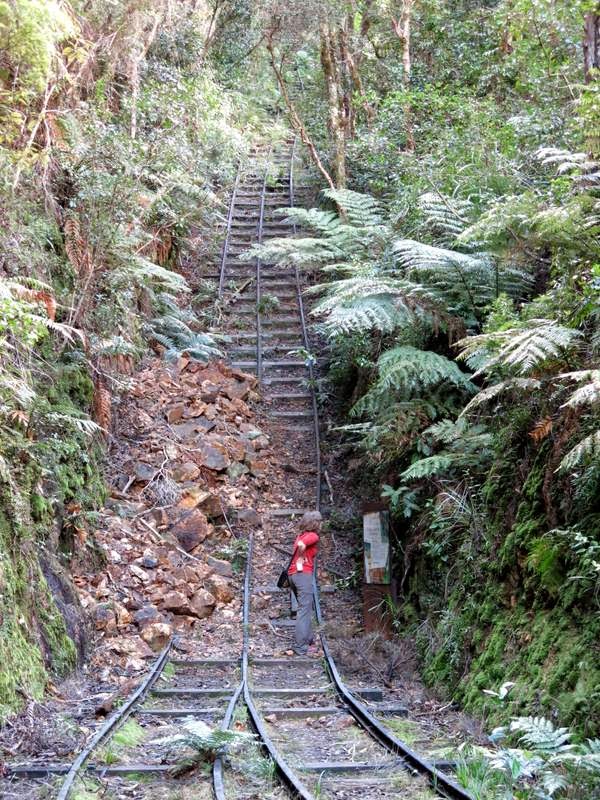


Needless to say, we quite enjoyed hiking the island -- and we only had time to scratch the surface!


Saturday, August 2, 2014

Safety culture

We noticed in New Zealand that there is a much calmer attitude about not saving everyone from their own stupidity than in the US.
For example:
River crossing without railings
 right above this:

Warning sign about abandoned mine shaft
without any actual physical barrier.

They expect people to take some modicum of responsibility for their own self-preservation -- it seems quite reasonable to me.

Friday, August 1, 2014

Happy Dirty Monster

I picked up my Happy Dirty Small Monster after 12 days of camp this morning, and was amused to note that the counselors (in the orange shirts) really don't look that much bigger than her anymore.

She has since fumigated herself, and laundry is running.

Caves!

Some of the many things we explored in New Zealand were caves.  The island has quite a bit of limestone, and thus many interesting caverns.  There are a few well-known big ones that you can only go in as part of a guided tour, but we were generally in happy-go-lucky, exploring-on-our-own mode, and sought out more obscure places that we could poke around without being part of a group.

First up was Waipu Cave.  This is an undeveloped cave up in the northern part of the island near Whangarei.  We drove over hill and dale on a twisty-turny dirt road, parked behind a gate on some farmer's field, and walked across the field to this sign.

After 25 meters on a muddy slippery trail, we found the opening

and went in.

We each had a headlamp, and Chad and I both had pretty powerful flashlights too, so we could see well enough to clamber down the entrance, across the stream, and into the pitch black part of the cave our of sight of the entrance.  However, photography with the adventure camera and no tripod was challenging.  I messed around with camera settings, and we strategically aimed flashlights to do our best to give you an idea of what it was like.


After working our way into the third big chamber, we turned off all the lights.  Spooky dark!
The really cool thing about this part was that the top of the cave was covered with glowworms, and as our eyes adjusted we could make out an amazing display of the luminescent larvae above us.  It looked like a densely star-filled night sky, right there in the cave.  My camera was not up to the task, but Google "glow worm cave" to see what these things actually look like.  Apparently the glow worms are brighter when they are hungry.  These ones seemed hungry.  It was really quite an unusual sight.

It was raining, leading to some uncertainty about rising water levels, and we still had a long drive planned for the rest of the day, so we opted not to push through and explore further, though our book indicated that there was 150 meters more muddy fun to be had further in the interior maze.

Later in the trip, when we found ourselves in the area near the more famous Waitomo Caves, we took a hike in a neat little preserve to see the Ruakuri Tunnels.  This is also a limestone region, with both entrances to some bigger caves (which you can explore in guided groups) and a delightful maze of a trail that wound its way along the creek and through a couple of small cave tunnels.  Having already seen some pretty spectacular glowworms for free up north, we opted for the do-it-yourself free hike.

The trail wound along the creek, involving several bridges across the creek

and pathways tacked along the edge of the creek

past cave entrances full of rushing water
and interesting tunnels


Nimue found lots of drips.
I kept finding intriguing little side entrances to the cave system.  This one I deemed too slippery to take the small one up into.

but we thought this one looked plausible.


Indeed.  I climbed up to check it out, and then back down to spot Nimue and Chad while they clambered up, and then back up myself.

Ooooh, more passageways, well above the stream level.  How fun.

Also photographically challenging, given my little camera
We played with different camera and light settings; the two below are of exactly the same location.  The lower picture is a better depiction of what it felt like.

At one point, I shone the light upward and saw a bunch of giant bugs on the cave ceiling above us:
Cave weta.  These guys are several inches across.
Undeterred, we did some more exploring

At another point, I climbed up into an adjoining passage above where we were.  An actual rock climbing move was needed for that one, so it was fun!  By this point, I could balance myself on the wet limestone, aim the flashlight, and operate the camera all at once.
Happy peoples.  We conveniently did caves on both of the days it really rained a lot.
After escaping this cave system and exploring further down the road to find a waterfall, we headed back towards Otorohanga and ate at a restaurant called "The Thirsty Weta", which seemed appropriate.


Sheep

We did see lots of these where we were in New Zealand,
 but many more of these,

and some empty fields too.
I gather than the main sheep area is further south than where we were.