Tuesday, August 5, 2014

Last thoughts from New Zealand

Can you tell I'm in a rush to get these all done?  It's a brave effort to get enough pictures up before we head out to visit Linda so we have pictures to talk about :)

Here are a few last thoughts from the NZ portion of our trip, in no particular order.

Welcome to Middle Earth.  We pretty much avoided the touristy Lord of the Rings stuff, except for the unavoidable statue at the airport.  It was pretty clear why the locations were good for that particular set of movies, though.

An honest-to-goodness pay phone that I made a toll-free call from to summon the rental car shuttle. (I could have used my cell, which worked and gave me free data all over the country, but I couldn't resist the now-retro method.)

Nimue is the huggiest kid in the universe!

Nice scenery everywhere.


We spent the whole trip joking about "Concealed Fish Hooks".

Chad coveted every single little camper van.

Nimue likes sheep.  We got a note from the B&B owner that the pregnant one had her lambs shortly after we left.

Sometimes paying for the zipline activity is just worth it.  Kiddo's eyes glowed afterwards.

Family hikes are good.


 Visual interest is also found in the details.


 Always have bread, sausage, and cheese on hand.

 Maori art is cool.
 Mmmmm, silly cider and local satumas.

And the most interesting, most complex, yummiest cider in the known universe.

 Almost-12-year-olds are fun to be with.

 Chad always finds a bike shop.

And did I mention more scenery?


Birds

We had a lot of fun chasing birds around New Zealand, mostly because the cast of characters was so different than what we are accustomed to at home.  Here are some highlights:

Kiwi Birds
The first three nights, we stayed in a cottage at Aroha Island, a kiwi preserve up on the north part of the island.  The benefit of this is that we were allowed to stumble around after dark looking for kiwi.  It turns out that kiwi really don't like light.  The really really don't like light so much that if you want to see them, the only light you can use when walking about is a dim, red, filtered light.   

We also learned that they also find the light of the full moon a bit off-putting, and of course we were there when there was a big bright full moon.

As we wandered about in the dark, we could definitely *hear* the birds poking about in the brush looking for food, and we heard the occasional call, but we couldn't actually see any, as they all stayed in the deepest darkest corners they could find.  Still, it was very interesting to sit silently outside in the bush in the dark, listening to all the night noises.  Bringing the focus down to just one sense when exceedingly jet-lagged was sort of surreal, but it brought about an intense set of awareness of the surroundings that us mostly urban dwellers don't often experience.  Very cool to listen to the kiwi, even if we didn't see any in the wild.

We did see a couple in the Otorohanga Kiwi House later in the trip.  Very funny-looking birds -- sort of like two animate drumsticks with a large beak, running around in circles.  And of course, one ran across representations of kiwi everywhere.

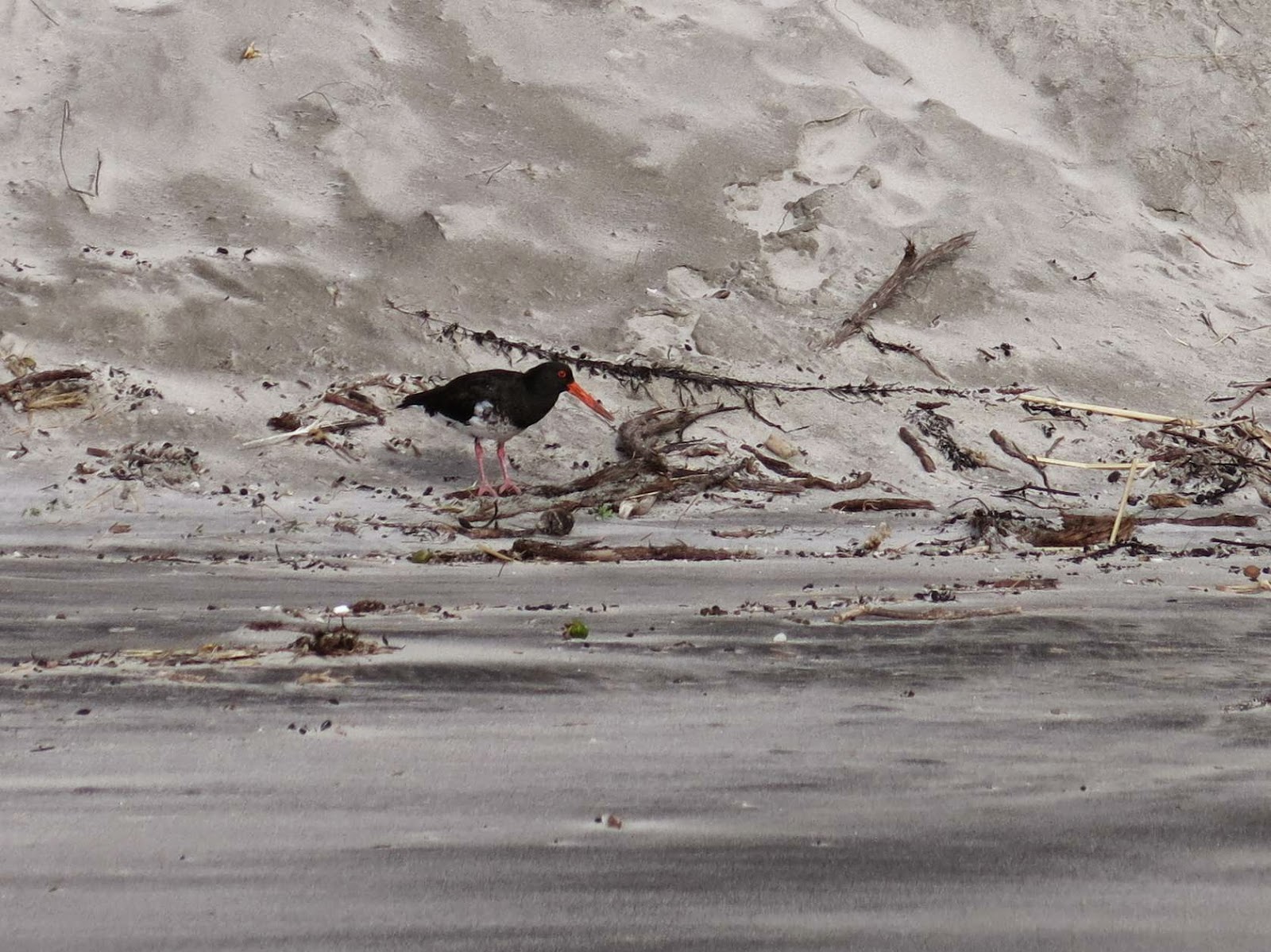
We found oystercatchers all over the beaches.  Given the number of oysters and other shellfish uncovered on the rocks at low tide, this wasn't surprising.  I like their bright orange beaks and eyes.

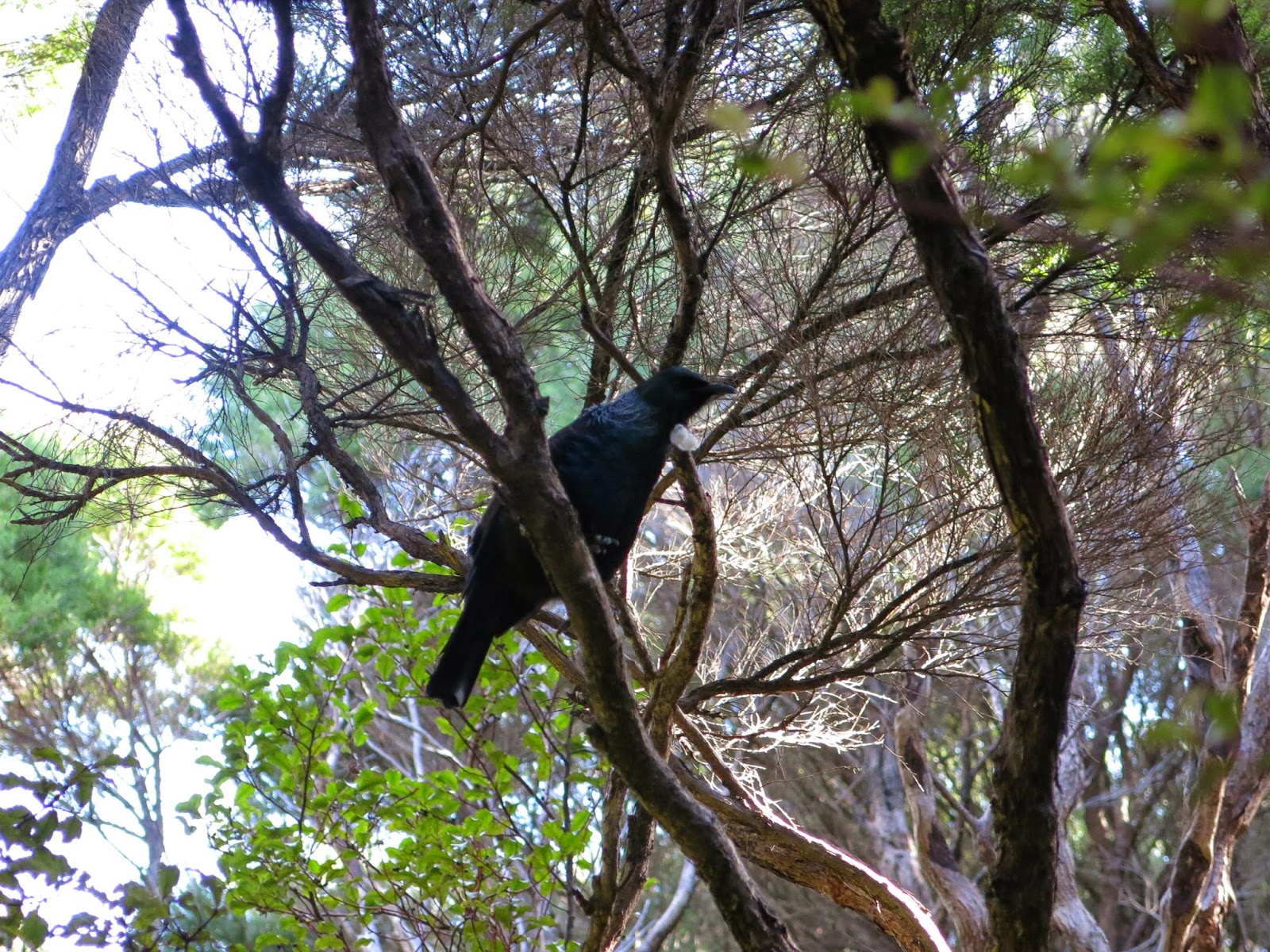
Tui.  We called this one the R2-D2 bird, as it can make the most amazing series of varied sounds with its two voice boxes.  These were all over the place, and according to one of the staff at Aroha Island, have different calls in different parts of the island due to their habit of mimicking all interesting local sound sources.  We did hear one that sounded just like a car alarm at one point.


The silver tree fern.  Not a bird, but the defining plant of the forested areas where we went, and in my mind they are associated with all the bird noises.


New Zealand Swamp Hen.  These were so surprisingly colorful for birds just wandering about in the warm pools at the city park.
 Baby swamp hen.  Cute!


Also not a bird, but this tree's roots looked just like a big bird foot.  The moa, the island's largest bird, is now extinct, but one might imagine it had a foot like this.  Either that, or the also-extinct giant eagles that used to eat the moa.

Black swans.  We also saw these all over the place.

I think this one is a kawaupaka, a type of cormorant.  He had a scenic spot to hang out.

Probably the most common bird we saw:  the fantail, or piwakawaka in Maori.  These were ubiquitous, and had a goofy random-seeming flight pattern, until you realized they constantly scoop up bugs as they fly.  Very agile little critters.


The spur-winged plover that followed us all the way around
 the Otorohanga Kiwi House.

One of Nim's favorites, the New Zealand Scaup.


Very Fat New Zealand Pigeon.  Birds here had no traditional land predators, which I guess drove the pigeons to be extra big.

North Island Kaka.  This guy was curious and crazed, but it may just be that he knew lunch was coming!

Kea.

Ooops -- also not a bird.  This one is a tree tomato, or tamarillo.  I ate one of these at breakfast one morning without knowing what it was, and then found out that most people cut them in half and scoop out the goopy stuff inside (I chowed the whole thing).  Not bad.

One of the big problems for the birds in New Zealand in this day and age are invasive predators of the mustelid family.  Nimue likes mustelids, so had to pose by the poster describing their evils.

Ooooh -- a gull.
 Nimue knows what to do about these.

Even the geese were different.  I can't help but wonder if these ones are good eating.  Must mean it is time to go make dinner.

Sunday, August 3, 2014

Charming New Zealand Guidbook

In case you were wondering *how* we found all the little back corners of New Zealand that we enjoyed, it is all due to this delightful guidebook I bought before we went.
The author clearly likes to be outside, isn't afraid to explore, and delights in places that aren't crowded.  I've always found that the places I enjoy most on trips aren't the first-tier tourist attractions that everyone visits, but rather the off-the-beaten-track discoveries.  One of the more charming features of the book is that each location is labelled with an "Obscure-O-Meter" rating.  I'm sure my delight in that is somewhat influenced by my mom's bad habit in my youth of picking the faintest little gray roads on the map to follow just to see where they went.

On any given day all we needed to do was pick the most interesting nearby destination.  As you have already seen, that worked well :)  One could also probably get by just by following the little brown signs indicating Department of Conservation sites and hiking the tracks at those locations -- these are all over the place, and the trails are clearly carefully engineered.

Some neat spots we found not mentioned in previous posts:

Mangawhai Cliffs -- an absolutely delightful walk along a beach and the bluff above it.  We headed to the coast and did this on the first morning off the plane because the weather was spectacularly nice for winter.


Aroha Island -- a kiwi preserve that we stayed at for a few nights.  We were able to stumble around the preserve's trails in the dark looking for kiwi (more on that in a later post), but it was also a good place to explore in the daylight.


Akeake Historic Reserve -- the site of an old Maori pa, or defensive site.  This one wasn't in the book; the nice folks running Aroha Island recommended it to us.  Gorgeous views of the Bay of Islands, and  a rocky beach near Opito Point on which to play.


(don't miss me clambering on the rocks near the point above)

Various and sundry waterfalls -- these are all over the place!
 Columnar basalt on the way to one of the aforementioned falls.

Innocent-looking rock outcrops...
that are chock-full of giant fossilized oysters.

Imported California Redwoods...
on the way to Hamurana Springs.  The water that wells up here travels for 70 years through aquifers from the plateau to the south, somehow avoiding all the geothermal plumbing under Rotorua, and emerges  from this 50 foot pit at a rate of about 4 million liters per hour.

A side spring where water wells up and make the sand dance.

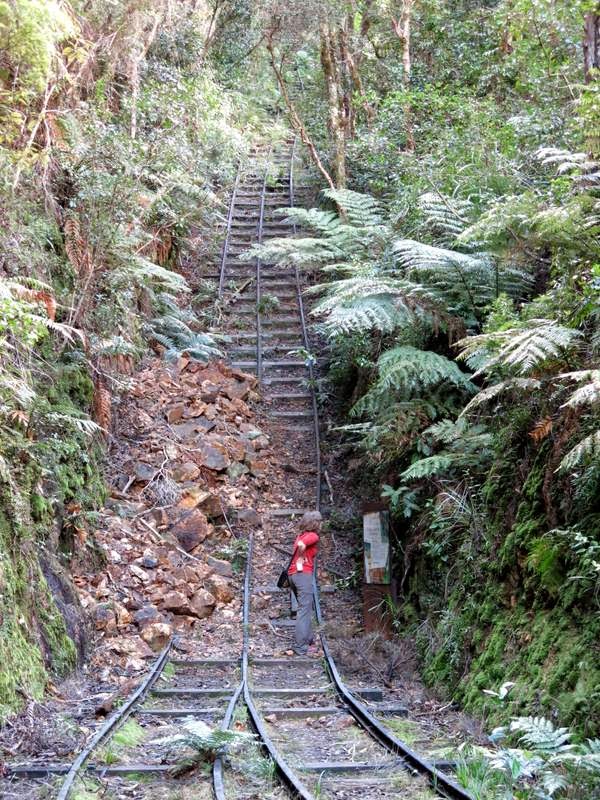
Waiorongomai Valley -- an abandoned 1880's-era gold rush site.  

What? you didn't know about the New Zealand Gold Rush??  Neither did we, until reading the many interpretive panels.  It didn't last long or produce much, as the first lines of the c. 1890 "Lament to Waiorongomai" attest:
O Wrong are you, O Wrong am I,
O Wrong all of us.
We are all sold.  There is no gold.
The claim's not worth a cuss.

Still interesting to see the remains, especially for those of us who periodically run across relics of the California version.  Many of the trails here follow the old tram lines up and across the hillside, and there are old mining tunnels and bits of aging equipment scattered about, as well as nice views.


Needless to say, we quite enjoyed hiking the island -- and we only had time to scratch the surface!


Saturday, August 2, 2014

Safety culture

We noticed in New Zealand that there is a much calmer attitude about not saving everyone from their own stupidity than in the US.
For example:
River crossing without railings
 right above this:

Warning sign about abandoned mine shaft
without any actual physical barrier.

They expect people to take some modicum of responsibility for their own self-preservation -- it seems quite reasonable to me.

Friday, August 1, 2014

Happy Dirty Monster

I picked up my Happy Dirty Small Monster after 12 days of camp this morning, and was amused to note that the counselors (in the orange shirts) really don't look that much bigger than her anymore.

She has since fumigated herself, and laundry is running.